
| Overview | Books | Journals | Documents | Database |
|
Scholarship
|
|
Distance Learning
|
|
Vocational
Training
|
|
Friendship
Camps
|
|
Documentation
and Information
|
Government Level Cooperation among SAARC countries
POVERTY ERADICATION
The Sixth SAARC Summit (Colombo, 1991) accorded the highest priority to the alleviation of poverty in South Asia and decided to establish an Independent South Asian Commission on Poverty Alleviation (ISACPA) consisting of eminent persons from member states to conduct an in-depth study of the diverse experiences of member states and report their recommendations on the alleviation of poverty to the Seventh Summit.
A consensus on poverty eradication was adopted at the Seventh SAARC Summit (Dhaka, 1993). The Summit welcomed the ISACPA report and expressed its commitment to eradicate poverty from South Asia preferably by the Year 2002 through an agenda of action which would, inter-alia, include a strategy of social mobilization, policy of decentralised agricultural development and small-scale labour-intensive industrialisation and human development. The Summit also stressed that within the conceptual approach of "Dhal-Bhaat", the right to work and primary education should receive priority. It also underscored the critical links between the success of national efforts at poverty alleviation and relevant external factors. The Summit urged major actors in the world economic scene to create an enabling atmosphere supportive of poverty alleviation programmes and expressed the need for a new dialogue with donors for this purpose. The call for a new dialogue with donors has led to important initiatives in this respect, among which was the SAARC/World Bank Informal Workshop on Poverty Reduction in South Asia (Annapolis, USA, October 1993). UNDP and ESCAP are formulating proposals for cooperation with SAARC in Poverty Reduction.
The Eighth SAARC Summit (New Delhi, May 1995) endorsed the recommendations of the Finance/Planning Ministers (Dhaka, July 1994) to establish a three-tier mechanism for exchanging information on poverty eradication. India hosted the meetings of the first and the second tier in New Delhi (September 1995). The meeting of the first tier
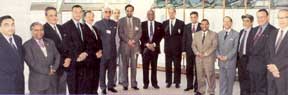
Group of Secretaries dealing with Poverty Eradication and Social Development in Member Countries during their meeting in New Delhi to address Poverty Eradication issues in the region. which constituted the Group of Secretaries to the Governments in the Ministries / Departments concerned with poverty eradication and social development in SAARC countries, underscored the need to give a distinct status and top priority to pro-poor plans in member countries ensuring specific commitment of adequate resource and organisational support. It also stressed the necessity to involve the poor in the formulation and implementation of plans meant for them through participatory institutions and process at grass root levels. The member states were also urged to evolve mechanisms to evaluate the efficacy of pro-poor plans and develop appropriate socio-economic indicators relevant for the purpose. On specific issues germane to poverty eradication, the meeting emphasised the need to pursue an integrated approach taking into account the critical linkages among various sectors.
The Meeting of the second-tier, i.e. Finance and Planning Secretaries, endorsed the recommendation of the first-tier and emphasised that poverty eradication should be viewed in the overall context of accelerating economic growth resulting in resulting in employment generation in an environment of macro-economic stability with emphasis on overall human resource development. The meeting also put special emphasis on the need to improving the implementation of poverty eradication programmes through devolution of power and decentralisation. A special mention was also made in the meeting on the need to ensure the sustainability of these programmes, especially through ensuring their recurring cost.
The Meeting of the third-tier Finance and Planning Ministers, is proposed to he held in India on 3-4 January 1996 which will consider the second-tier Report. Its recommendations will be submitted to the Ninth SAARC Summit through the Council of Ministers.
| Poverty Eradication | Read document |
| Trade and Economic Cooperation | Read document |
| Promoting People-to-People Contact | Read document |
| POVERTY ERADICATION |