
| Overview | Books | Journals | Documents | Database |
|
Scholarship
|
|
Distance Learning
|
|
Vocational
Training
|
|
Friendship
Camps
|
|
Documentation
and Information
|
Government Level Cooperation among SAARC countries
PROMOTING PEOPLE-TO-PEOPLE CONTACT
1. The Second SAARC Summit (Bangalore, 1986) laid special emphasis on promoting people-to-people contact in the region and approved the following five initiatives in this regard:
1. SAARC Audio-Visual Exchange (SAVE) Programme
The SAVE programmes comprise of regular TV and Radio Programmes which are being telecast/broadcast on the 1st and 15th of each month respectively in all SAARC member countries. SAVE Radio and TV Quiz Programmes are also being held at regular intervals and have evoked keen interest among the youth. The other programmes include joint productions on specific Themes such as Environment, Disabled Persons and Youth. SAVE has proved to be an effective medium for promoting South Asian consciousness amongst the peoples of the region and for establishing people-to-people contact.
2. SAARC Documentation Centre (SDC)
The Centre has been established to provide ready access to reliable and up-to-date information on technical, scientific and development matters.
3. SAARC Scheme for Promotion of Organised Tourism
The Scheme was initiated with the over-all objective of people-to-people contact in the region and more specifically as a step to facilitate development of intra-regional tourism. Confessional air fare to the tourists travelling under the Scheme is now under the consideration of the Technical Committee on Tourism which is presently taking necessary action to ensure early implementation of the Scheme.
4. SAARC Chairs, Fellowships and Scholarships Scheme
The SAARC Chairs, Fellowships and Scholarships Scheme was instituted with the aim of providing increased cross-fertilization of ideas through greater interaction among students, scholars and academics in the SAARC Countries. This Scheme has now been brought under the purview of the Technical Committee on Education, Culture and Sports.
5. SAARC Youth Volunteers Programme (SYVOP)
a.The main objective of the SYVOP is to harness the idealism of Youth for regional cooperation programmes by enabling them to work in other countries in the field of agriculture and forestry extension work. SYVOP was brought under the purview of the Technical Committee on Rural Development in 1989. Seven activities have so far been held in the member countries under this programme.
b. Other initiatives taken by the Organisation for promoting people-to-people contact include the following :
1. SAARC Visa Exemption Scheme
In order to further promote closer and more frequent contacts among the peoples of the region, the SAARC Visa Exemption Scheme was initiated in 1988. The Scheme became operational from March 1, 1992 and so far about 1600 visas have been issued under the Scheme. Currently, persons entitled to the Scheme are the Supreme Court Judges, Members of the National Parliaments, Heads of National Academic Institutions, Foreign/Permanent Secretaries dealing with foreign affairs, SAARC Secretary-General and Directors of the SAARC Secretariat, Presidents of National Chambers of Commerce and Industry and their accompanying spouses and dependent children below 18 years of age.
2. South Asian Festivals
The First South Asian Festival was held in India from 9-24 October 1992 with popular participation from all member states. The festival which included performing arts, exhibitions and seminars was a unique event and served to enhance the interaction and strengthened the affinities among the peoples of South Asia. The festival also served to focus on the civilisational personality of South Asia manifested in the rich heritage of its art forms, architecture, literature, theater and films.
South Asian Festivals covering selected areas would be organised in future in member countries.
3. Non-Governmental Organizations (NGOs)
SAARC has emphasized the need for strengthening intergovernmental efforts with increased peopletopeople contacts through greater participation of NGOs, including professional bodies in the private sector, to promote socio-economic and cultural development of South Asia. In this context, a set of guidelines and procedures for granting recognition by SAARC to Regional Apex Bodies has been formulated.
While the following regional apex bodies have been welcomed/granted recognition by SAARC, applications for recognition from several other apex bodies of professionals such as architects, accountants, university women etc. are presently under consideration :
(i) Association of SAARC Speakers and Parliamentarians
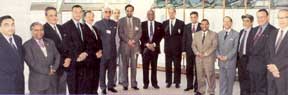
The Speakers of Parliaments of SAARC Countries first met in Sri Lanka in June 1992 and resolved to set up an Association of SAARC Speakers and Parliamentarians. They met in Kathmandu in November 1992 and The First South Asian Festival held in India (October 1992) with participation from all Member Countries was a unique event which focused on the rich cultural heritage of South Asia formally launched the "Association of SAARC Speakers and Parliamentarians" and adopted the Charter of the Association. The Speakers Council which is the Apex Body of the Association finalised and ratified the draft rules of the Association prepared by the Parliamentary Secretaries-General in January 1994. Since then they have met periodically and addressed issues of common interest to member countries. The Heads of State or Government at their Seventh Summit (Dhaka, April 1993) welcomed the initiative of the Speakers of Parliaments of SAARC Countries in forming the Association
(ii) SAARC Chamber of Commerce and Industry (SCCI)
The SAARC Chamber of Commerce and Industry (SCCI) was recognised by SAARC in December 1992.
SCCI has established its headquarters at Karachi and national units in all seven SAARC countries. Mr. S.M. Inam was elected as the first President of SCCI. The establishment of SCCI is a significant development and it will act as a dynamic instrument of promoting regional cooperation in the areas of trade and economic relations.
The SAARC Chamber has been instrumental in disseminating the information about the content, scope, and potential of the Framework Agreement on SAARC Preferential Trading Arrangement (SAPTA) among the business community in the region. For this purpose, it has organised, under its aegis, various National Seminars on SAPTA in the Member Countries. A Regional Seminar on SAPTA was also organised in Kathmandu in December 1994 by the Federation of Nepalese Chambers of Commerce and Industry in cooperation with the SAARC Chamber of Commerce and Industry and Friedrich-Naumann-Stiftung.
SCCI delegations, headed by its President and comprising representatives of the National Federations of Chambers of Commerce and Industry of SAARC Member States, have visited Germany and Japan for expanding the exports from the SAARC region to the European Union and Japan.
In view of expanding activities of the SCCI in the field of promoting trade both within and outside the SAARC region, SAARC has decided to continue its recognition to SCCI for a period of five years.
The present President of SCCI is Mr. Salman F. Rahman, President of FBCCI, who was elected in October 1995.
(iii) Saarclaw
SAARCLAW - an Association for persons of the legal communities of the SAARC countries, established in 1991 with its headquarters in Colombo was recognised by SAARC as a regional apex body in July 1994. Established with the twin objectives of bringing together the legal communities within the region for closer cooperation and developing law as a source towards social change for development, SAARCLAW has been convening periodic conferences covering important areas of common interest to member countries. Since the establishment, SAARCLAW has held regional conferences in Colombo (1991), Karachi (February 1993), New Delhi (January 1994), and Kathmandu (April 1995). The fifth regional conference is to be held in Dhaka in January 1996. Since the Kathmandu conference, the parallel meeting of the Chief Justices of member countries would become a regular feature during the future conferences of SAARCLAW.
In addition, SAARCLAW is engaged in
(a)
exchange of personnel (lawyers, Judges, Academics),
(b) establishment of a SAARCLAW library in each country,
(c) harmonisation of laws which offer mutual assistance within the judicial
process,
(d) publication of SAARCLAW magazine, and
(e) establishment of a SAARC Arbitration Centre.
| Poverty Eradication | Read document |
| Trade and Economic Cooperation | Read document |
| Promoting People-to-People Contact | Read document |
| POVERTY ERADICATION |