
| Overview | Books | Journals | Documents | Database |
|
Scholarship
|
|
Distance Learning
|
|
Vocational
Training
|
|
Friendship
Camps
|
|
Documentation
and Information
|
Agreement on SAARC Preferential Trading Arrangement
PREAMBLE
The Government of the People's Republic of Bangladesh, the Kingdom of Bhutan, the Republic of India, the Republic of Maldives, the Kingdom of Nepal, the Islamic Republic of Pakistan and the Democratic Socialist Republic of Sri Lanka hereinafter referred to as "Contracting States",
Motivated by the commitment to promote regional cooperation for the benefit of their peoples, in a spirit of mutual accommodation, with full respect for the principles of sovereign equality, independence and territorial integrity of all States;
Aware that the expansion of trade could act as a powerful stimulus to the development of their national economies, by expanding investment and production, thus providing greater opportunities of employment and help securing higher living standards for their population;
Convinced of the need to establish and promote regional preferential trading arrangement for strengthening intraregional economic cooperation and the development of national economies; Bearing in mind the urgent need to promote the intraregional trade which presently constitutes a negligible share in the total volume of the South Asian trade;
Recalling the direction given at the Fourth SAARC Summit meeting held in Islamabad in December 1988 that specific areas be identified where economic cooperation might be feasible immediately;
Guided by the declared commitment of the Heads of State or Government of the Member Countries at the Sixth SAARC Summit held in Colombo in December 1991 to the liberalisation of trade in the region through a step by step approach in such a manner that countries in the region share the benefits of trade expansion equitably;
Cognizant of the mandate given by the Sixth SAARC Summit in Colombo to formulate and seek agreement on an institutional framework under which specific measures for trade liberalisation among SAARC Member States could be furthered and to examine the Sri Lankan proposal to establish the SAARC Preferential Trading Arrangement (SAPTA) by 1997;
Recognising that a preferential trading arrangement is the first step towards higher levels of trade and economic cooperation in the region,
Have agreed as follows:
Article 1 - Definitions for the purpose of this Agreement
(1)
"Least Developed Country" means a country designated as such
by the United Nations.
(2) "Contracting State" means any Member State of the South
Asian Association for Regional Cooperation (SAARC) which has entered
into this Agreement.
(3) "Serious injury" means significant damage to domestic
producers, of like or similar products resulting from a substantial
increase of preferential imports in situations which cause substantial
losses in terms of earnings, production or employment unsustainable
in the short term. The examination of the impact on the domestic industry
concerned shall also include an evaluation of other relevant economic
factors and indices having a bearing on the state of the domestic industry
of that product.
(4) "Threat of serious injury" means a situation in which
a substantial increase of preferential imports is of a nature to cause
"serious injury" to domestic producers, and that such injury,
although not yet existing, is clearly imminent. A determination of threat
of serious injury shall be based on facts and not on mere allegation,
conjecture, or remote or hypothetical possibility.
(5) "Critical circumstances" means the emergence of an exceptional
situation where massive preferential imports are causing or threatening
to cause "serious injury" difficult to repair and which calls
for immediate action.
(6) "Sectoral basis" means agreements amongst Contracting
States regarding the removal or reduction of tariff, nontariff and paratariff
barriers as well as other trade promotion or cooperative measures for
specified products or groups of products closely related in enduse or
in production.
(7) "Direct trade measures" means measures conducive to promoting
mutual trade of Contracting States such as long and mediumterm contracts
containing import and supply commitments in respect of specific products,
buyback arrangements, state trading operations, and government and public
procurement.
(8) "Tariffs" means customs duties included in the national
tariff schedules of the Contracting States.
(9) "Paratariffs" means border charges and fees, other than
"tariffs", on foreign trade transactions of a tarifflike effect
which are levied solely on imports, but not those indirect taxes and
charges, which are levied in the same manner on like domestic products.
Import charges corresponding to specific services rendered are not considered
as paratariff measures.
(10) "Nontariffs" means any measure, regulation, or practice,
other than "tariffs" and "paratariffs", the effect
of which is to restrict imports, or to significantly distort trade.
(11) "Products" means all products including manufactures
and commodities in their raw, semiprocessed and processed forms.
Article 2 - Establishment and Aims
1.
By the present Agreement, the Contracting States establish the SAARC
Preferential Trading Arrangement (SAPTA) to promote and sustain mutual
trade and the economic cooperation among the Contracting States, through
exchanging concessions in accordance with this Agreement.
2. SAPTA will be governed by the provisions of this Agreement and also
by the rules, regulations, decisions, understandings and protocols to
be agreed upon within its framework by the Contracting States.
Article 3 - Principles
SAPTA shall be governed in accordance with the following principles
(a)
SAPTA shall be based and applied on the principles of overall reciprocity
and mutuality of advantages in such a way as to benefit equitably all
Contracting States, taking into account their respective levels of economic
and industrial development, the pattern of their external trade, trade
and tariff policies and systems;
(b) SAPTA shall be negotiated step by step, improved and extended in
successive stages with periodic reviews;
(c) The special needs of the Least Developed Contracting States shall
be clearly recognised and concrete preferential measures in their favour
should be agreed upon;
(d) SAPTA shall include all products, manufactures and commodities in
their raw, semiprocessed and processed forms.
Article 4 - Components
SAPTA may, interalia, consist of arrangements relating to:
(a)
tariffs;
(b) paratariffs;
(c) nontariff measures;
(d) direct trade measures.
Article 5 - Negotiations
1. The Contracting States may conduct their negotiations for trade liberalisation in accordance with any or a combination of the following approaches and procedures:
(a)
Product by product basis;
(b) Across the board tariff reductions;
(c) Sectoral basis;
(d) Direct trade measures.
2.
Contracting States agreed to negotiate tariff preferences initially
on a productbyproduct basis.
3. The Contracting States shall enter into negotiations from time to
time with a view to further expanding SAPTA and the fuller attainment
of its aims.
Article 6 - Additional Measures
1.
Contracting States agree to consider, in addition to the measures set
out in Article 4, the adoption of trade facilitation and other measures
to support and complement SAPTA to mutual benefit.
2. Special consideration shall be given by Contracting States to requests
from Least Developed Contracting States for technical assistance and
cooperation arrangements designed to assist them in expanding their
trade with other Contracting States and in taking advantage of the potential
benefits of SAPTA. The possible areas for such technical assistance
and cooperation are listed in Annex I.
Article 7 - Schedules of Concessions
The tariff, paratariff and nontariff concessions negotiated and exchanged amongst Contracting States shall be incorporated in the National Schedules of Concessions. The initial concessions agreed to by the Contracting States are attached as Annex II.
Article 8 - Extension of Negotiated Concessions
The concessions agreed to under SAPTA, except those made exclusively to the Least Developed Contracting States in pursuance of Article 10 of this Agreement, shall be extended unconditionally to all Contracting States.
Article 9 - Committee of Participants
A Committee of Participants, hereinafter referred to as the Committee, consisting of representatives of Contracting States, is hereby established. The Committee shall meet at least once a year to review the progress made in the implementation of this Agreement and to ensure that benefits of trade expansion emanating from this Agreement accrue to all Contracting States equitably. The Committee shall also accord adequate opportunities for consultation on representations made by any Contracting State with respect to any matter affecting the implementation of the Agreement. The Committee shall adopt appropriate measures for settling such representations. The Committee shall determine its own rules of procedures.
Article 10 - Special Treatment for the Least Developed Contracting States
1. In addition to other provisions of this Agreement, all Contracting States shall provide, wherever possible, special and more favourable treatment exclusively to the Least Developed Contracting States as set out in the following subparagraphs:
(a)
Duty-free access, exclusive tariff preferences or deeper tariff preferences
for the export products,
(b) The removal of nontariff barriers,
(c) The removal, where appropriate, of paratariff barriers,
(d) The negotiations of longterm contracts with a view to assisting
Least Developed Contracting States to achieve reasonable levels of sustainable
exports of their products,
(e) Special consideration of exports from Least Developed Contracting
States in the application of safeguard measures,
(f) Greater flexibility in the introduction and continuance of quantitative
or other restrictions provisionally and without discrimination in critical
circumstances by the Least Developed Contracting States on imports from
other Contracting States.
Article 11 - Nonapplication
Notwithstanding the measures as set out in Articles 4 and 6, the provisions of this Agreement shall not apply in relation to preferences already granted or to be granted by any Contracting State to other Contracting States outside the framework of this Agreement, and to third countries through bilateral, plurilateral and multilateral trade agreements, and similar arrangements. The Contracting States shall also not be obliged to grant preferences in SAPTA which impair the concession extended under those agreements.
Article 12 - Communication
Transport and Transit Contracting States agree to undertake appropriate steps and measures for developing and improving communication system, transport infrastructure and transit facilities for accelerating the growth of trade within the region.
Article 13 - Balance of Payments Measures:
1.
Notwithstanding the provisions of this Agreement, any Contracting State
facing serious economic problems including balance of payments difficulties
may suspend provisionally the concessions as to the quantity and value
of merchandise permitted to be imported under the Agreement. When such
action has taken place, the Contracting State which initiates such action, shall
simultaneously notify the other Contracting States and the Committee.
2. Any Contracting State which takes action according to paragraph 1
of this Article shall afford, upon request from any other Contracting State, adequate opportunities for consultations
with a view to preserving the stability of the concessions negotiated
under the SAPTA. If no satisfactory adjustment is effected between the
Contracting States concerned within 90 days of such notification, the
matter may be referred to the Committee for review.
Article 14 - Safeguard Measures
If
any product, which is a subject of a concession with respect to a preference
under this Agreement, is imported into the territory of a Contracting
State in such a manner or in such quantities as to cause or threaten
to cause, serious injury in the importing Contracting State, the importing
Contracting State concerned may, with prior consultations, except in
critical circumstances, suspend provisionally without discrimination,
the concession accorded under the Agreement. When such action has taken
place the Contracting State which initiates such action shall
simultaneously notify the other Contracting State(s) concerned and the
Committee shall enter into consultations with the concerned Contracting
State and endeavour to reach mutually acceptable agreement to remedy
the situation.
In the event of the failure of the Contracting States to resolve the
issue within 90 days of the receipt of original notification, the Committee
of Participants shall meet within 30 days to review the situation and
try to settle the issue amicably. Should the consultations in the Committee
of Participants fail to resolve the issue within 60 days, the parties
affected by such action shall have the right to withdraw equivalent
concession(s) or other obligation(s) which the Committee does not disapprove
of.
Article 15 - Maintenance of the Value of Concessions
Any of the concessions agreed upon under this Agreement shall not be diminished or nullified, by the application of any measures restricting trade by the Contracting States except under the provisions as spelt out in other Articles of this Agreement.
Article 16 - Rules of Origin
Products contained in the National Schedules of Concessions annexed to this Agreement shall be eligible for preferential treatment if they satisfy the rules of origin, including special rules of origin, in respect of the Least Developed Contracting States, which are set out in Annex III.
Article 17 - Modification and Withdrawal of Concessions
1.
Any Contracting State may, after a period of three years from the day
the concession was extended, notify the Committee of its intention to
modify or withdraw any concession included in its appropriate schedule.
2. The Contracting State intending to withdraw or modify a concession
shall enter into consultation and/or negotiations, with a view to reaching
agreement on any necessary and appropriate compensation, with Contracting
States with which such concession was initially negotiated and with
any other Contracting States that have a principal or substantial supplying
interest as may be determined by the Committee.
3. Should no agreement be reached between the Contracting States concerned
within six months of the receipt of notification and should the notifying
Contracting State proceed with its modification
or withdrawal of such concessions, the affected Contracting States as
determined by the Committee may withdraw or modify equivalent concessions
in their appropriate schedules. Any such modification or withdrawal
shall be notified to the Committee.
Article 18 - Withholding or Withdrawal of Concessions
A Contracting State shall at any time be free to withhold or to withdraw in whole or in part any item in its schedule of concessions in respect of which it determines that it was initially negotiated with a State which has ceased to be a Contracting State in this Agreement. A Contracting State taking such action shall notify the Committee, and upon request, consult with Contracting States that have a substantial interest in the product concerned.
Article 19 Consultations:
1.
Each Contracting State shall accord sympathetic consideration to and
shall afford adequate opportunity for consultations regarding such representations
as may be made by another Contracting State with respect to any matter affecting
the operation of this Agreement.
2. The Committee may, at the request of a Contracting State, consult with any Contracting State in respect of any matter for which
it has not been possible to find a satisfactory solution through such
consultation under paragraph 1 above.
Article 20 - Settlement of Disputes
Any dispute that may arise among the Contracting States regarding the interpretation and application of the provisions of this Agreement or any instrument adopted within its framework shall be amicably settled by agreement between the parties concerned. In the event of failure to settle a dispute, it may be referred to the Committee by a party to the dispute. The Committee shall review the matter and make a recommendation thereon within 120 days from the date on which the dispute was submitted to it. The Committee shall adopt appropriate rules for this purpose.
Article 21 - Withdrawal from SAPTA:
1.
Any Contracting State may withdraw from this Agreement at any time after
its entry into force. Such withdrawal shall be effective six months
from the day on which written notice thereof is received by the SAARC
Secretariat, the depositary of this Agreement. That Contracting State shall simultaneously inform the
Committee of the action it has taken.
2. The rights and obligations of a Contracting State which has withdrawn from this
Agreement shall cease to apply as of that effective date.
3. Following the withdrawal by any Contracting State, the Committee shall meet within
30 days to consider action subsequent to withdrawal.
Article 22 - Entry into Force
This Agreement shall enter into force on the thirtieth day after the notification issued by the SAARC Secretariat regarding completion of the formalities by all Contracting States.
Article 23 - Reservations
This Agreement may not be signed with reservations nor shall reservations be admitted at the time of notification to the SAARC Secretariat of the completion of formalities.
Article 24 - Amendments
This Agreement may be modified through amendments to this Agreement. All amendments shall become effective upon acceptance by all Contracting States.
Article 25 - Depositary
This Agreement shall be deposited with the Secretary General of SAARC who shall promptly furnish a certified copy thereof to each Contracting State.
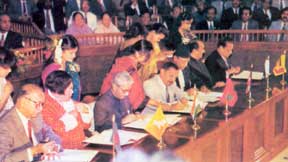
IN WITNESS WHEREOF the undersigned being duly authorized thereto by their respective Governments have signed this Agreement on the SAARC Preferential Trading Arrangement.
Done at DHAKA this ELEVENTH day of APRIL One Thousand Nine Hundred Ninety Three in eight originals in the English language.
A.S.M. MOSTAFIZUR RAHMAN, Minister of Foreign Affairs Minister of Foreign Affairs People's Republic of Bangladesh
DAWA TSERING, Minister of Foreign Affairs, Kingdom of Bhutan
DINESH SINGH, Minister of External Affairs, Republic of India
FATHULLA JAMEEL, Minister of Foreign Affairs, Republic of Maldives
MAHESH ACHARYA, State Minister of Finance, His Majesty's Government of Nepal
MOHAMMAD SIDDIQUE KHAN KANJU, Minister of State for Foreign Affairs, Islamic Republic of Pakistan
HAROLD HERAT, Minister of Foreign Affairs, Democratic Socialist Republic of Sri Lanka
Annex
I
ADDITIONAL MEASURES IN FAVOUR OF LEAST DEVELOPED CONTRACTING
STATES
(a)
The identification, preparation and establishment of industrial and
agricultural projects in the territories of Least Developed Contracting
States which could provide the production base for the expansion of
exports of Least Developed Contracting States to other Contracting States,
possibly linked to cooperative financing and buyback arrangements;
(b) the setting up of manufacturing and other facilities in Least Developed
Contracting States to meet intra-regional demand under cooperative arrangements;
(c) the formulation of export promotion policies and the establishment
of training facilities in the field of trade to assist Least Developed
Contracting States in expanding their exports and in maximising their
benefits from SAPTA;
(d) the provision of support to export marketing of products of Least
Developed Contracting States by enabling these countries to share existing
facilities (for example, with respect to export credit insurance, access
to market information) and by institutional and other positive measures
to facilitate imports from Least Developed Contracting States into their
own markets;
(e) bringing together of enterprises in other Contracting States with
project sponsors in the Least Developed Contracting States (both public
and private) with a view to promoting joint ventures in projects designed
to lead to the expansion of trade;
(f) the provision of special facilities and rates in respect to shipping.
Annex
II
National Schedules of Concessions (circulated
separately)
Annex
III
RULES
OF ORIGIN
RULE 1: Originating products - Products covered by preferential trading arrangements within the framework of the SAPTA imported into the territory of a Contracting State from another Contracting State which are consigned directly within the meaning of Rule 5 hereof, shall be eligible for preferential concessions if they conform to the origin requirement under any one of the following conditions:
(a)
Products wholly produced or obtained in the exporting Contracting State
as defined in Rule 2; or
(b) Products not wholly produced or obtained in the exporting Contracting State, provided that the said products
are eligible under Rule 3 or Rule 4.
RULE 2: Wholly produced or obtained - Within the meaning of Rule 1 (a) the following shall be considered as wholly produced or obtained in the exporting Contracting State:
(a)
raw or mineral products extracted from its soil, its water or its seabeds:1
(b) agricultural products harvested there;2
(c) animals born and raised there;
(d) products obtained from animals referred to in paragraph (c) above;
(e) products obtained by hunting or fishing conducted there;
(f) products of sea fishing and other marine products taken from the
high seas by its vessels;
3/4
(g) products processed and/or made on boards its factory ships
4/5
exclusively from products referred to in paragraph (f) above;
(h) used articles collected there, fit only for the recovery of raw
materials;
(i) waste and scrap resulting from manufacturing operations conducted
there;
(j) goods produced there exclusively from the products referred to in
paragraph (a) to (i) above.
RULE
3 : Not wholly produced
or obtained
(a) Within the meaning of Rule 1(b), products worked on or processed
as a result of which the total value of the materials, parts or produce
originating from nonContracting States or of undetermined origin used
does not exceed 50 per cent of the f.o.b. value of the products produced
or obtained and the final process of manufacture is performed within
the territory of the exporting Contracting State shall be eligible for
preferential concessions subject to the provisions of Rule 3(c) and
Rule 4.
(b) Sectoral agreements
6
(c) The value of the nonoriginating materials, parts or produce shall
be:
(i)
The c.i.f. value at the time of importation of materials parts or produce
where this can be proven: or
(ii) The earliest ascertainable price paid for the materials, prices
or produce of undetermined origin in the territory of the Contracting State where the working or processing
takes place.
RULE 4: Cumulative rules of origin - Products which comply with origin requirements provided for in Rule 1 and which are used by a Contracting State as input for a finished product eligible for preferential treatment by another Contracting State shall be considered as a product originating in the territory of the Contracting State where working or processing of the finished product has taken place provided that the aggregate content originating in the territory of the Contracting State is not less than 60 percent of its f.o.b. value7.
RULE
5 : Direct consignment
- The following shall be considered as directly consigned from the exporting
Contracting State to the importing Contracting State:
(a) if the products are transported without passing through the territory
of any non-Contracting State:
(b) the products whose transport involves transit through one or more
intermediate nonContracting States with or without transhipment or temporary
storage in such countries, provided that:
(i)
the transit entry is justified for geographical reason or by considerations
related exclusively to transport requirements;
(ii) the products have not entered into trade or consumption there;
and
(iii) the products have not undergone any operation there other than
unloading and reloading or any operation required to keep them in good
condition.
RULE 6: Treatment of packing - When determining the origin of products, packing should be considered as forming a whole with the product it contains. However, packing may be treated separately if the national legislation so required.
RULE 7: Certificate of Origin - Products eligible for preferential concessions shall be supported by a Certificate of Origin8 issued by an authority designated by the government of the exporting Contracting State and notified to the other Contracting States in accordance with the Certification Procedures appearing on pages 15 and 16 of this Annex.
RULE 8:
(a)
In conformity with Article 15 of the Agreement on SAPTA and national
legislations, any Contracting State may prohibit importation of products
containing any inputs originating from States with which it does not
have economic and commercial relations.
(b) Contracting States will do their best to cooperate in order to specify
origin of inputs in the Certificate of Origin.
RULE 9: Review - These Rules may be reviewed as and when necessary upon request of one-third of the Contracting States and may be open to such modifications as may be agreed upon.
RULE 10: Special criteria percentage- Products originating in Least Developed Contracting States can be allowed a favourable 10 percentage points applied to the percentage established in Rules 3 and 4. Thus, for Rule 3, the percentage would not exceed 60 per cent, and for Rule 4, the percentage would not be less than 50 per cent.
1
Include mineral fuels, lubricants and related materials as well as mineral
of metal ores.
2 Include
forestry products.
3 "Vessels"
shall refer to fishing vessels engaged in commercial fishing, registered
in a Contracting State's country and operated by a citizen or citizens
or governments of Contracting State or partnership, corporation or association,
duly registered in such Contracting State's country, at cost 60 per
cent of equity of which is owned by a citizen or citizens and/or government
of such Contracting State or 75 percent by citizens and/or governments
of the Contracting States. However, the products taken from vessels
engaged in commercial fishing under bilateral agreements which provide
for chartering/leasing of such vessels and/or sharing of catch between
Contracting States will also be eligible for preferential concessions.
4 In
respect of vessels or factory ships operated by government agencies
the requirement of flying the flag of a Contracting State does not apply.
5 For
the purpose of this Agreement, the term "factory ship" means
any vessels, as defined, used for processing and/or making on board
products exclusively from those products referred to in paragraph (f)
above.
6 In
respect of products traded within the framework of sectoral agreements
negotiated under SAPTA, provision may need to be made for special criteria
to apply. Consideration may be given to these criteria as and when the
sectoral agreements are negotiated.
7 "Partial"
cumulation as implied by Rule 4 above means that only products which
have acquired originating status in the territory of one Contracting
State may be taken into account when used as inputs for a finished product
eligible for preferential treatment in the territory of another Contracting
State.
8 A
standard Certificate of Origin to be used by all Contracting States
is annexed and approved by the Contracting States.
ADDENDUM
Amendment to SAPTA Rules of Origin
The SAARC Council of Ministers at its Twenty-first Session held in Nuwara Eliya, Sri Lanka, on 18-19 March 1999, approved the amendments to the Rules 3(a), 4 and 10 relating to the Rules of Origin (Annex-II) of the SAARC Preferential Trading Arrangement (SAPTA) with immediate effect.
The new amended rules now read as follows:
Rule 3(a): Not wholly produced or obtained ?
Within the meaning of Rule 1(b), products worked on or processed as a result of which the total value of the materials, parts or produce originating from non-Contracting States or of undetermined origin used does not exceed 60 per cent of the f.o.b. value of the products produced or obtained and the final process of manufacture is performed within the territory of the exporting Contracting State shall be eligible for preferential concessions subject to the provisions of Rule 3(c) and Rule 4.
Rule 4: Cumulative rules of origin ?
Products which comply with origin requirements provided for in Rule 1 and which are used by a Contracting State as input for a finished product eligible for preferential treatment by another Contracting State shall be considered as a product originating in the territory of the Contracting State where working or processing of the finished product has taken place provided that the aggregate content originating in the territory of the Contracting State is not less than 50 percent of its f.o.b. value.
Rule 10: Special criteria percentage ?
Products originating in Least Developed Contracting States can be allowed a favourable 10 percentage points applied to the percentage established in Rules 3 and 4. Thus, for Rule 3, the percentage would not exceed 70 per cent, and for Rule 4, the percentage would not be less than 40 per cent.